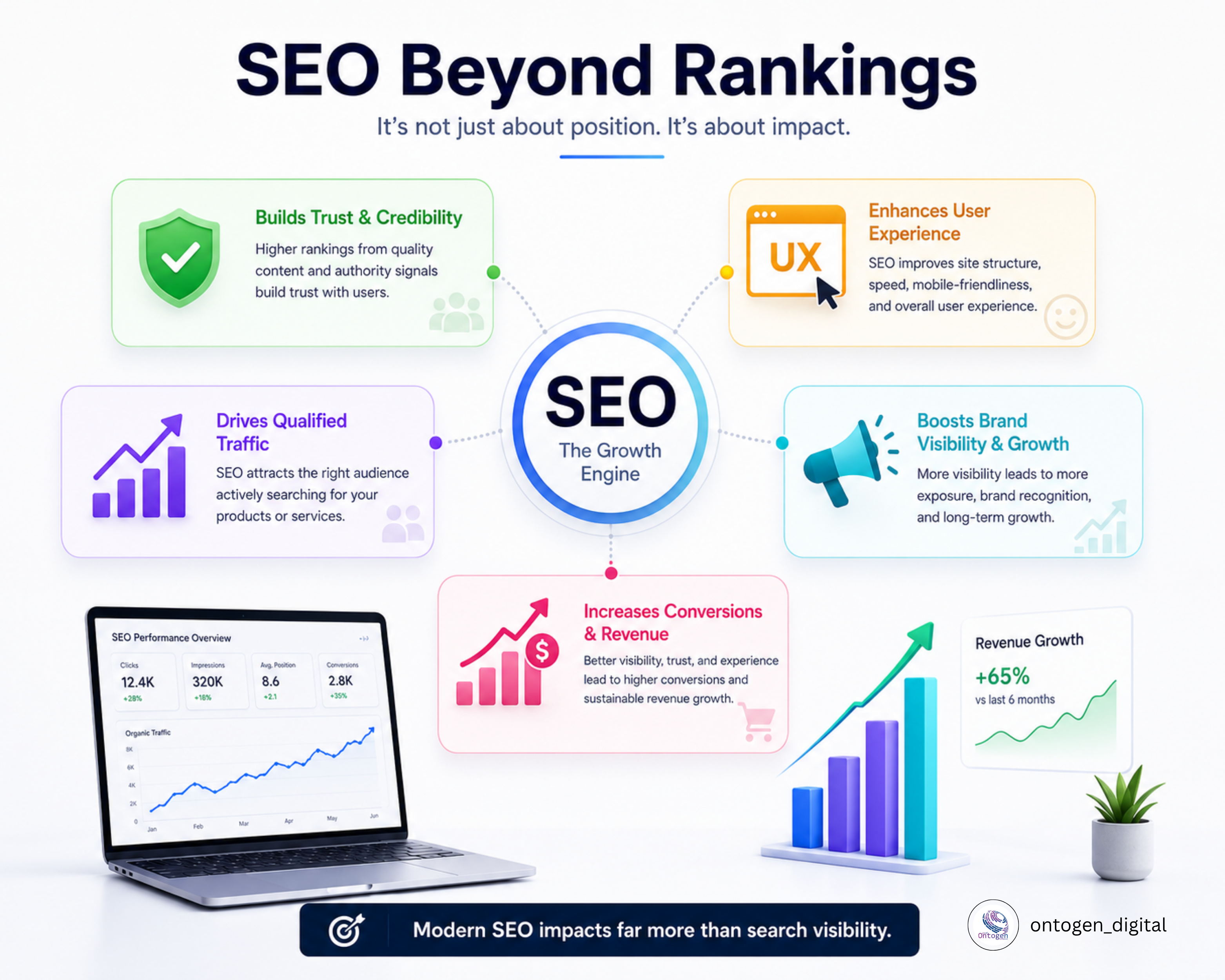
In the digital marketing world, SEO is often reduced to one metric: rankings.
Businesses celebrate when they move from page three to page one on Google. Agencies showcase keyword reports. Marketers track traffic spikes after optimization campaigns. While rankings matter, they are only the visible outcome of something much bigger.
The truth is that SEO has evolved far beyond a technical exercise designed to impress search engines.
Today, SEO influences how customers perceive a brand, how users experience a website, how businesses make strategic decisions, and even how offline sales grow. It impacts trust, visibility, conversions, customer retention, and long-term profitability in ways many business owners fail to recognize.
For small businesses and startups especially, this misunderstanding can be costly.
When SEO is viewed only as a rankings game, companies often underestimate its strategic value. They stop investing too early, chase shortcuts, or prioritize vanity metrics over sustainable growth. But businesses that understand the hidden advantages of SEO often build stronger digital ecosystems, lower customer acquisition costs, and create long-term authority in their industry.
This is why modern SEO is no longer just a marketing tactic. It is a business growth framework.
In this guide, we will explore the deeper benefits of SEO marketing that go beyond visibility. We will look at how SEO improves credibility, enhances user experience, strengthens local business growth, provides market intelligence, and supports long-term scalability.
More importantly, we will show how businesses can use SEO strategically instead of treating it as a checklist.
SEO Builds Brand Credibility Before Customers Even Click
One of the most overlooked advantages of SEO is psychological trust.
Consumers naturally associate high search rankings with authority and reliability. Even when users know that search results are generated by algorithms, they still subconsciously trust businesses that appear near the top.
Research in consumer psychology consistently shows that visibility creates perceived credibility.
When a business ranks highly for important industry keywords, customers assume the following:
The business is established
The company is trusted by others
The brand has expertise
The website is relevant and reliable
This trust is created before the user even visits the website.
Think about how people search online today. A homeowner looking for roofing services in Texas, a startup founder searching for CRM software, or a local customer looking for the best café nearby often chooses businesses that appear first because they feel safer.
This behavior is especially important for small businesses competing against larger companies.
A strong SEO presence can help a smaller company appear more trustworthy than competitors with larger advertising budgets.
For example, many local law firms in the United States invest heavily in content-driven SEO strategies. Instead of relying entirely on paid ads, they publish educational content answering specific legal questions. Over time, this positions them as trusted experts in their region. Their rankings become credibility signals.
The same pattern can be seen in India.
Brands like Zerodha built enormous trust partly through educational SEO-focused content. Their blogs, guides, and knowledge resources helped users associate the brand with expertise and transparency long before they became industry leaders.
This is one of the hidden powers of SEO:
It creates reputation equity.
Unlike ads, which disappear when budgets stop, organic visibility compounds over time. Every optimized article, landing page, and educational resource contributes to a stronger brand perception.
Businesses that consistently appear in search results become mentally familiar to consumers. Familiarity builds trust. Trust increases conversions.
That cycle is difficult to replicate with short-term marketing tactics alone.
SEO Reduces Customer Acquisition Costs Over Time
Paid advertising can generate quick traffic.
But there is a problem most businesses eventually face:
cost escalation.
As competition increases, advertising costs rise. Platforms like Google Ads and Meta Ads become more expensive. Customer acquisition costs grow. Campaign performance fluctuates.
SEO operates differently.
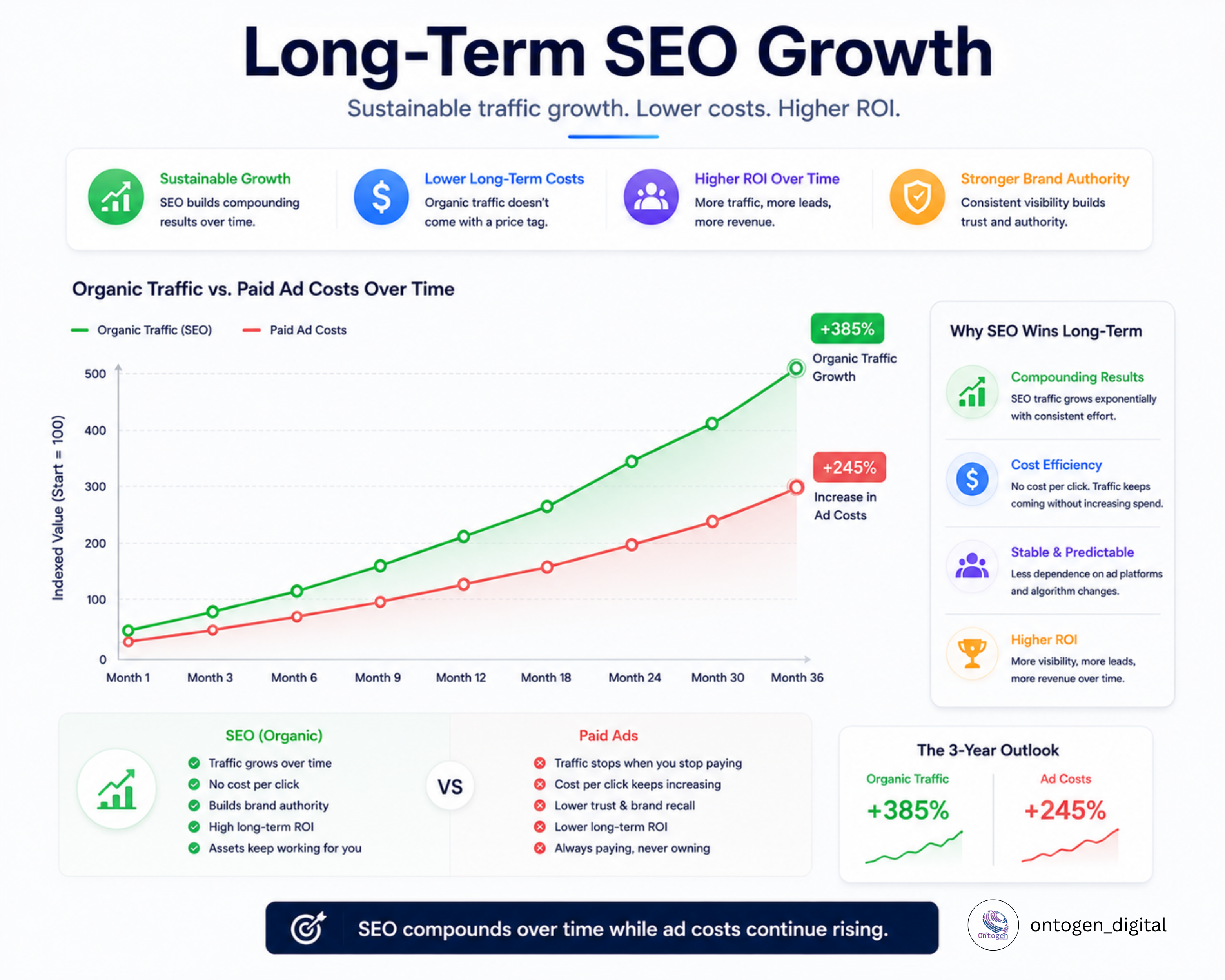
Instead of renting visibility, businesses build digital assets that continue generating traffic long after the initial investment.
This is why SEO often delivers one of the strongest long-term returns on investment in digital marketing.
An optimized blog post can attract visitors for years.
A strong service page can generate leads every month without ongoing ad spend.
A well-structured local SEO campaign can consistently drive nearby customers.
Over time, this creates compounding growth.
Imagine two companies:
Company A spends $8,000 monthly on ads without investing in SEO.
Company B invests in SEO content, technical optimization, and authority building alongside moderate ad campaigns.
Initially, Company A may generate faster results. But after 18–24 months, Company B often develops a sustainable stream of organic traffic that reduces dependency on paid campaigns.
This changes the economics of marketing entirely.
SEO lowers reliance on constantly increasing ad budgets.
For startups and SMBs, this matters enormously because marketing budgets are usually limited. Businesses need scalable channels that continue working even during economic slowdowns.
According to industry studies from major marketing research firms, organic traffic often converts better than cold paid traffic because users arrive with stronger intent. They are actively searching for solutions instead of being interrupted by advertisements.
This leads to:
Lower acquisition costs
Better conversion rates
Higher-quality leads
Improved lifetime customer value
A practical example can be seen in many US-based home service businesses.
Local HVAC companies that invest in SEO frequently dominate searches like "emergency AC repair near me" or "Best heating repair in Dallas."
These rankings consistently produce leads without paying per click every time someone searches.
Over several years, the financial advantage becomes significant.
SEO is not cheap in the beginning.
But strategically executed SEO becomes cheaper over time.
That distinction is critical.
Read also: Guide to On-Page SEO (Free Checklist)
SEO Improves User Experience And Better UX Increases Revenue
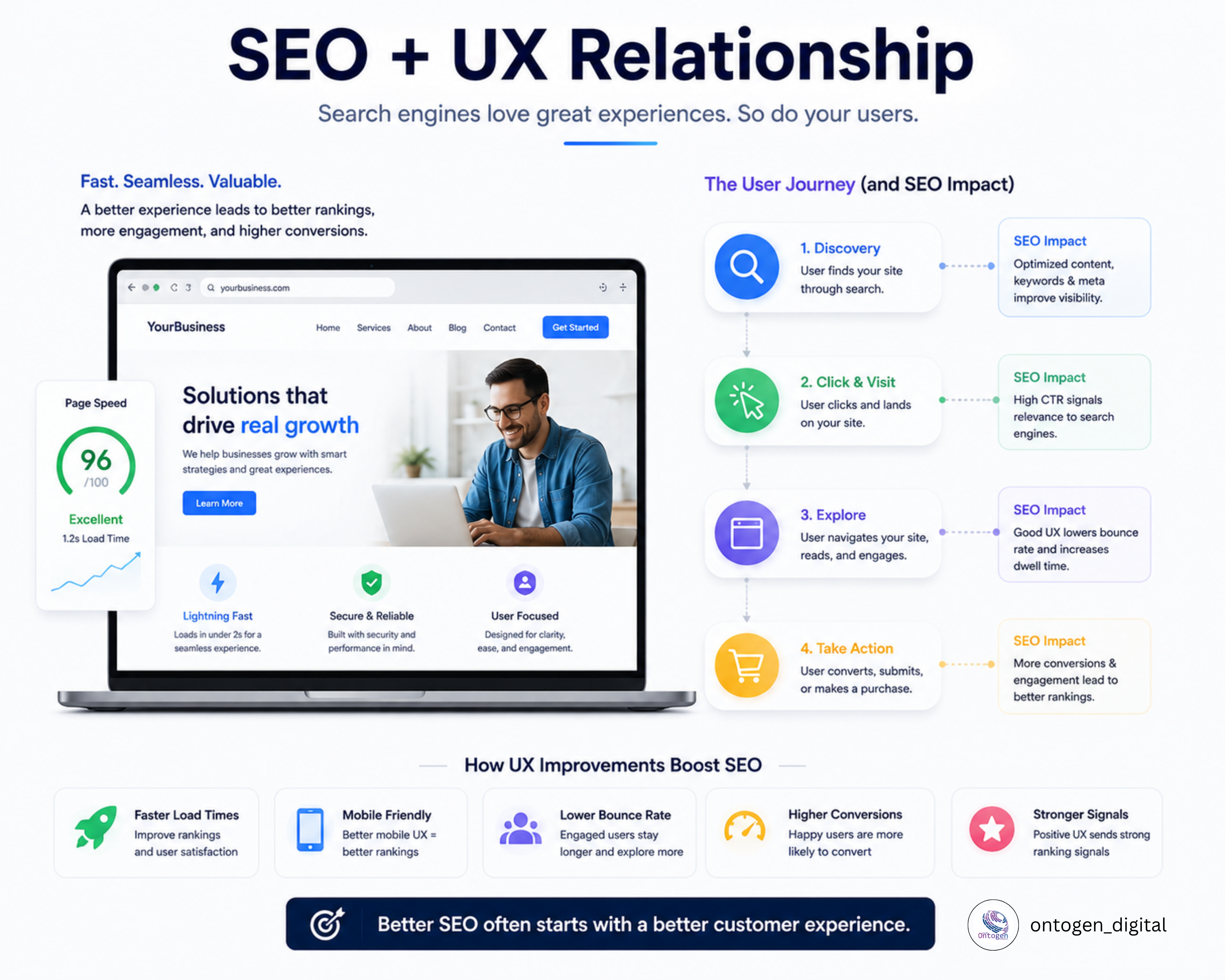
Google's ranking systems increasingly prioritize user experience.
This means businesses cannot succeed in SEO while ignoring website quality.
To rank well, websites must:
Load quickly
Work properly on mobile devices
Offer intuitive navigation
Deliver useful content
Reduce friction during browsing
As a result, SEO naturally pushes businesses toward creating better digital experiences.
This is one of the hidden benefits many companies discover only after investing seriously in optimization.
Their websites become easier to use.
This directly impacts revenue.
A slow website frustrates users.
A confusing layout increases bounce rates.
Poor navigation reduces conversions.
When SEO specialists optimize a site technically, they are not only helping search engines understand pages. They are also improving how real people interact with the business online.
For example, improving Core Web Vitals often results in:
Faster page loading
Better mobile usability
Higher engagement
Lower abandonment rates
This improves both rankings and customer satisfaction simultaneously.
Consider modern e-commerce behavior.
Consumers expect speed. Research consistently shows that users abandon pages that take too long to load. Even a few seconds of delay can reduce conversion rates dramatically.
SEO optimization frequently identifies these performance issues early.
Indian e-commerce platforms like Nykaa invested heavily in mobile optimization and user-focused content because their audience primarily browsed on smartphones. Better usability improved engagement while strengthening organic visibility.
This relationship between SEO and UX is becoming stronger every year.
Search engines increasingly reward websites that prioritize real user value.
That means effective SEO is no longer about manipulating algorithms.
It is about improving experiences.
Businesses that understand this shift build stronger digital brands.
Local SEO Impacts Offline Revenue More Than Most Businesses Realize
Many business owners think SEO only benefits online companies.
That assumption is outdated.
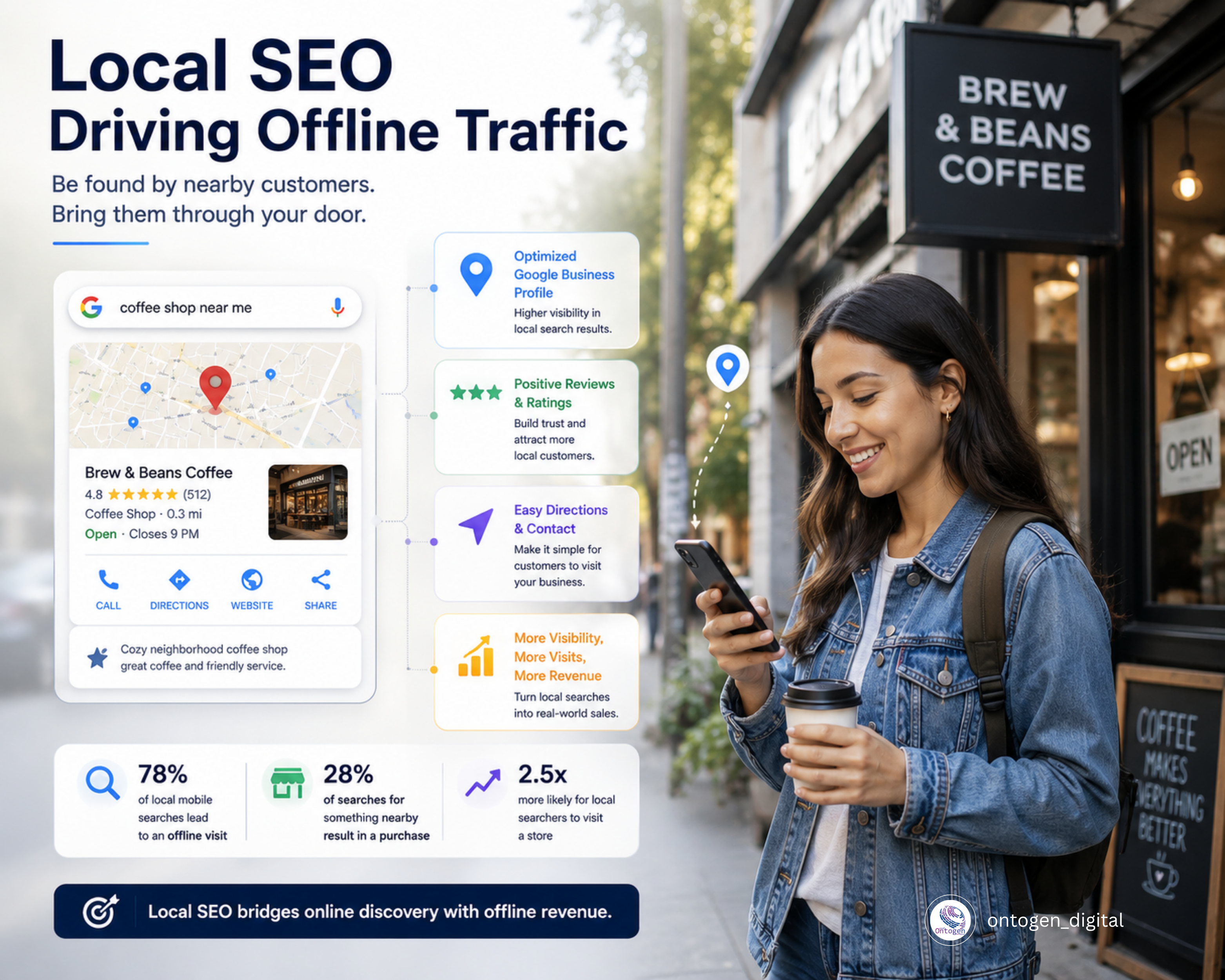
Local SEO has become one of the strongest drivers of offline customer acquisition.
Today, consumers search online before making offline decisions.
They search for:
Restaurants
Clinics
Gyms
Cafés
Retail stores
Service providers
Repair shops
Real estate agencies
These searches often lead directly to physical visits.
When someone searches "best coffee shop near me" or "dentist in Chicago," Google's local results heavily influence where they go.
This is where local SEO becomes extremely powerful.
A properly optimized local presence includes the following:
Google Business Profile optimization
Local citations
Customer reviews
Location-based content
Mobile-friendly design
Local keyword targeting
These elements increase discoverability within a specific geographic region.
For small businesses, this creates a massive competitive opportunity.
A local business does not need nationwide visibility.
It needs visibility within the right radius.
For example, many independent restaurants in cities like Austin, Miami, and New York have grown primarily through local SEO visibility and review management.
The same trend is growing rapidly in India.
Local fashion boutiques, cafés, gyms, and clinics increasingly depend on Google Maps visibility and localized content to attract nearby customers.
This digital-to-physical connection is important because consumer behavior has permanently changed.
Even when customers intend to buy offline, their journey usually starts online.
SEO now influences foot traffic, phone calls, appointment bookings, and in-store purchases.
That makes it a revenue driver beyond e-commerce.
SEO Provides Market Intelligence Most Businesses Ignore
One of the most underrated benefits of SEO is data.
SEO tools reveal what customers are thinking, searching, comparing, and struggling with in real time.
This is incredibly valuable.
Search behavior reflects intent more accurately than many traditional market research methods.
When businesses analyze search trends, they gain insights into:
Customer pain points
Emerging demand
Seasonal interests
Competitor positioning
Product opportunities
Changing language patterns
This information can influence product development, content strategy, advertising campaigns, and sales messaging.
For example, during economic uncertainty, search patterns often shift toward affordability, value-driven services, comparisons, and budget alternatives.
Businesses monitoring SEO data can adapt quickly.
This agility is one reason why modern SEO should be viewed strategically rather than technically.
Search data acts like a live consumer behavior dashboard.
Consider how SaaS companies use SEO research.
If a software company notices growing searches around "AI workflow automation for small businesses," they can create targeted solutions and content before competitors fully react.
That early positioning advantage matters enormously.
SEO data also helps businesses understand audience language.
Customers may not describe problems the same way businesses do internally. Search queries reveal natural phrasing and concerns. Smart marketers use this insight across websites, ads, email campaigns, and product messaging.
This creates alignment between businesses and customer expectations.
In many ways, SEO is market research at scale.
Read also: Skyscraper SEO: Advantages and Techniques
Content-Driven SEO Creates Long-Term Authority
Content remains one of the strongest pillars of modern SEO.
But the real value of content marketing is not simply traffic generation.
It is authority building.
Educational content positions businesses as trusted advisors instead of sellers.
This distinction changes customer relationships significantly.
When businesses consistently answer important questions, explain industry concepts, and solve audience problems, they become recognized as reliable information sources.
That authority compounds over time.
For example, a cybersecurity company publishing detailed guides on ransomware prevention gradually becomes associated with expertise. Prospective customers begin trusting the brand before contacting sales teams.
This shortens sales cycles.
It also improves lead quality because educated buyers arrive with stronger confidence.
In the SMB space, authority is often a deciding factor.
Customers prefer businesses that demonstrate expertise clearly and consistently.
This is why long-form SEO content performs so well when executed properly.
It builds:
Visibility
Trust
Relevance
Brand recall
Engagement
Conversion confidence
Content-driven SEO also supports omnichannel marketing.
A single, well-researched article can become social media posts, email campaigns, video topics, webinar discussions, lead magnets, and sales enablement material.
This multiplies marketing efficiency.
Companies that treat content strategically create ecosystems rather than isolated campaigns.
The Strategic SEO Framework Smart Businesses Use
Many companies fail with SEO because they focus only on rankings.
Modern SEO requires a broader framework.
The most effective businesses approach SEO through five interconnected layers.
1. Technical Foundation
Without strong technical performance, even great content struggles.
This includes:
Site speed
Mobile responsiveness
Crawlability
Secure architecture
Structured data
Internal linking
Technical SEO creates the infrastructure for sustainable growth.
2. Search Intent Alignment
Modern SEO is about understanding why users search.
Businesses must create content that matches intent: informational, transactional, navigational, commercial investigation.
Intent alignment improves both rankings and conversions.
3. Authority Building
Authority comes from quality content, backlinks, expertise, consistent publishing, and trust signals.
Search engines increasingly reward brands with proven topical depth.
4. User Experience Optimization
SEO and UX are no longer separate disciplines.
Businesses must optimize navigation, readability, engagement, accessibility, and conversion flows.
Good UX improves behavioral metrics that influence organic performance.
5. Data-Driven Adaptation
Search trends evolve constantly.
Successful SEO strategies continuously adapt based on analytics, search behavior, competitor changes, algorithm shifts, and consumer trends.
This framework transforms SEO from a marketing tactic into a scalable business system.
Case Studies: Real-World SEO Impact Beyond Rankings
US SMB Example: Local Home Improvement Brand
A mid-sized home improvement company in Texas struggled with expensive lead generation costs from paid ads.
Initially, the business viewed SEO only as a way to rank for service keywords.
After implementing a broader SEO strategy, several unexpected benefits emerged:
Improved website speed reduced bounce rates
Educational content increased customer trust
Local SEO boosted map visibility
Organic leads converted better than paid leads
Customer reviews improved brand perception
Within 18 months, the company reduced dependence on paid advertising significantly while increasing qualified inquiries.
The biggest surprise was not rankings.
It was profitable.
Indian Example: D2C Brand Growth Through Content SEO
An Indian direct-to-consumer wellness brand focused heavily on educational SEO content around nutrition, health routines, and product education.
Instead of aggressively selling products, the brand prioritized solving customer questions.
Over time:
Organic traffic increased steadily
Repeat visitors grew
Brand searches increased
Customer trust improved
Social sharing expanded reach
The business became recognized as an authority rather than just another e-commerce store.
This improved both organic visibility and conversion performance.
The long-term impact extended far beyond search rankings.
Common SEO Mistakes That Limit Growth
Many businesses fail to experience SEO's full value because they approach it incorrectly.
One major mistake is focusing entirely on short-term rankings.
SEO is cumulative. Businesses expecting instant outcomes often abandon strategies before momentum builds.
Another common problem is publishing low-quality content purely for keywords.
Modern search engines prioritize relevance, expertise, and usefulness. Thin content rarely produces sustainable results.
Ignoring technical performance is another major issue.
A beautifully designed website can still fail if pages load slowly, mobile usability is poor, or site architecture is confusing.
Businesses also underestimate local SEO opportunities.
Many local companies invest heavily in social media while neglecting Google Business optimization, reviews, and local search visibility.
Finally, some brands separate SEO from broader marketing strategy.
This creates disconnected messaging and missed opportunities.
SEO works best when integrated with branding, paid advertising, content marketing, UX design, analytics, and conversion optimization.
The Future of SEO in 2026 and Beyond
SEO is evolving rapidly.
Artificial intelligence, voice search, zero-click results, and personalized search experiences are reshaping how users interact with information.
But despite these changes, one principle remains constant:
Search engines reward businesses that provide genuine value.
In 2026, successful SEO strategies will likely focus more heavily on topical authority, user experience, trust signals, multimedia content, AI-assisted personalization, and conversational search optimization.
Search behavior is also becoming more intent-driven.
Users increasingly expect immediate, accurate, and context-aware results.
Businesses that create comprehensive, helpful, and trustworthy experiences will outperform those chasing algorithm loopholes.
Another important shift is the growing integration between SEO and brand building.
Search engines increasingly evaluate reputation signals across the web: reviews, mentions, engagement, expertise, and authority.
This means SEO is becoming deeply connected with overall business credibility.
For SMBs, this creates opportunity.
Smaller brands that produce exceptional niche-focused content can compete effectively against larger competitors.
The future of SEO belongs to businesses that prioritize usefulness over manipulation.
How Ontogen Digital Helps Businesses Grow Strategically
At Ontogen Digital, SEO is approached as a long-term growth strategy rather than a rankings checklist.
The focus is not simply on increasing traffic but on building sustainable digital systems that generate measurable business outcomes.
Through tailored SEO services, businesses can improve visibility, strengthen authority, and attract high-intent customers organically.
But growth rarely comes from one channel alone. That is why integrated strategies matter.
That is why customized marketing strategies are essential for aligning SEO, paid media, branding, and customer acquisition into one scalable system.
The objective is simple: Build marketing ecosystems that continue driving growth long after campaigns launch.
Frequently Asked Questions
Is SEO still worth investing in during 2026?
Yes. SEO remains one of the most cost-effective long-term marketing channels because it builds sustainable visibility, authority, and customer trust over time.
How long does SEO take to show results?
Most businesses begin seeing measurable improvements within 3–6 months, but stronger long-term gains often develop over 12 months or more.
Why is SEO better than relying only on paid ads?
Paid ads stop generating traffic when budgets stop. SEO builds long-term digital assets that continue attracting customers organically.
Does SEO help local businesses?
Absolutely. Local SEO improves visibility in nearby searches, Google Maps results, and location-based queries that drive real-world visits and calls.
How does SEO improve user experience?
SEO encourages businesses to optimize site speed, mobile responsiveness, navigation, and content quality, all of which improve customer experience.
Can small businesses compete with larger brands using SEO?
Yes. Smaller businesses can compete effectively by targeting niche topics, local search intent, and high-quality content focused on specific customer needs.
What is the biggest hidden benefit of SEO?
Beyond rankings, SEO builds long-term credibility and trust, which improves conversions, customer loyalty, and brand authority.
Conclusion
Think of your website as a digital storefront. Many people focus only on how high their store appears when someone searches for a product, but that is only a small part of the story. When you organize your website to be helpful and easy to navigate, you are doing more than just trying to show up first on a list. You are making sure that whenever someone walks into your "store," they find exactly what they need, feel safe, and have a good experience. This makes them much more likely to trust you and come back again, which is how you build a real relationship with your customers.
When you treat your website as a helpful resource rather than just a way to get attention, you gain a major advantage. You learn what your customers care about, you save money by building a solid foundation instead of constantly paying for quick fixes, and your business grows steadily over time. Instead of just chasing a higher spot on a search result page, focus on building a useful, reliable space that makes life easier for the people you want to serve. This is how you create a lasting business that people genuinely respect and remember.
Explore the solutions offered by Ontogen Digital s and discover how a performance-driven marketing strategy can help your business grow sustainably in 2026 and beyond.