23
Feb 2026
Introduction: Why Roast Marketing Demands Strategy, Not Spontaneity
In 2026 the scroll never ends. Audiences spend their time in feeds and short video environments where attention is earned in seconds and memory is made in moments. Brands that blend into the background are forgotten; brands that create memorable moments get talked about, shared, and referenced. Roast marketing uses witty teasing, cultural commentary, and playful jabs in a deliberate way to create memorable moments.
But there's a catch. Roast marketing can either sharpen a brand’s edge or cut its reputation. The difference isn’t luck. It’s about discipline: having a clear strategy, knowing your audience’s sensitivity, staying true to your brand identity, and keeping risk controls in place. When a brand jokes without showing what it does, the humor feels hollow. When a brand roasts without cultural sensitivity, it invites backlash.
This guide is for brand managers, CMOs, founders, and ambitious marketers who want to evaluate roast marketing not as a meme stunt but as a deliberate strategic tool. We will explain how the tactic works both psychologically and algorithmically, share Indian examples and failures, provide a step-by-step execution playbook, cover legal and ethical boundaries, and show how to measure what really matters. If you want to use humor to build lasting brand equity, not just a viral spike, keep reading.
What Roast Marketing Actually Is (and Isn’t)
At a glance, roast marketing looks like clever jokes and snappy tweets. At its core, roast marketing is a more precise way of using humor to create emotional contrast that highlights brand personality, advantage, or cultural placement. It depends on three elements
Relatability: tapping shared experiences or frustrations so the audience recognizes themselves.
Contrast: juxtaposing your brand’s strengths against competitor habits, category myths, or everyday behavior.
Timing: launching the joke when cultural context makes it relevant, amplifying reaction and shareability.
Crucially, roast marketing is not about cruelty, baseless insults, or vulgarity. It’s not a license to attack vulnerable groups, mock tragedy, or make defamatory statements. Effective roast marketing is witty, transparent in intent, and tethered to truth; it amplifies product advantages or human truths rather than inventing falsehoods. Roast marketing should connect to long-term growth objectives through strategic digital marketing solutions.
Why Roast Marketing Resonates in 2026: Psychology + Platform Logic
Two dynamics explain the traction: human psychology and platform design.
Psychology shows that humor can be a powerful memory aid. When something makes us laugh, it tends to stick in our minds longer and feels easier to recall later. Using humor when trying to learn or remember information can make the process more enjoyable and effective. The cognitive science of attention shows that novelty and emotional arousal make content memorable. Roast marketing often creates surprise and schadenfreude, which is a small pleasure when a shared frustration is pointed out. These reactions help people think more deeply about the message. When a brand makes us laugh at ourselves, we let down our guard and become more open to the message they are sharing.
Platform mechanics are designed so that social algorithms reward engagement like reactions, comments, shares, saves, and replies. Humor, especially clever humor tied to current events or cultural moments, generates these interactions. Without an advanced SEO strategy, viral content rarely converts into sustainable organic traffic. A well-timed roast post can spark debate or friendly banter, spreading faster and reaching more people than a typical promotional post.
Simply, roast marketing combines psychological stickiness with algorithmic amplification. But because both elements can accelerate outcomes fast, poorly judged jokes can amplify negative reactions equally quickly. That’s why a controlled strategy is essential.
How Indian Brands Have Used Roast Marketing Lessons From Practice
India’s social environment is uniquely fertile for roast marketing. A massive young population, high social media literacy, and rich cultural references create fertile conditions for relatable humor. Several Indian brands provide instructive case studies.
Zomato: Roast the Habit, Not the Competitor
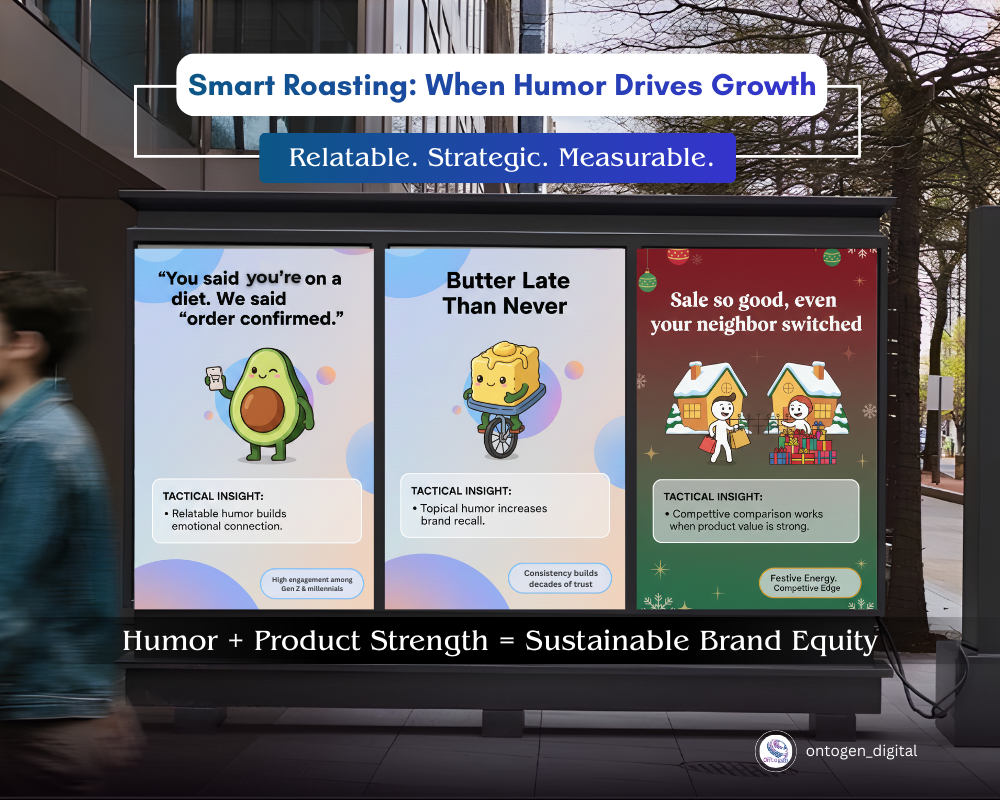
Zomato’s social tone is recognizable because it roasts the human condition around food, not competitors directly. Tweets that poke fun at diet starts, breakup orders, or festival binge behaviors feel inclusive. That strategy turns micro-moments into reasons to order: the joke itself subtly nudges the customer toward the core action of ordering food. Zomato’s success shows that roasting shared behavior, the “we all do this” moments, creates emotional affinity without legal risk.
Key takeaway: Roast the behavior your product solves; anchor the humor to a conversion path.
Swiggy: Real-Time, Contextual Humor
Swiggy often uses contextual events (IPL matches, rains, festivals) to create timely humor. Because their jokes are moment-sensitive, they feel natural rather than staged. Swiggy’s approach highlights timing and relevance as an amplification strategy; humor works best when it rides a cultural wave.
Key takeaway: Align roast content with real-time cultural moments to increase resonance.
Amul: Topical Wit with Institutional Memory
Amul is an older but instructive example: its topical hoardings have been cleverly commenting on cricket, politics, and popular culture for decades. The brand’s humor is observational and rarely vicious. Over time this consistency built trust and recall; customers expected Amul to “say something clever” on current events. Amul teaches patience: building a comedic voice over years reduces the risk of any single joke derailing your reputation.
Key takeaway: Build a consistent comedic identity over time to create durable brand equity.
Flipkart & Amazon: Competitive Banter That Stays Safe
During festive sales, both Flipkart and Amazon often use competitive banter hinting at features, delivery speed, and deals without naming names or making false claims. This keeps competitive tension high while avoiding direct defamation. Their playbook shows how to use implied comparisons, not accusatory claims.
Key takeaway: Subtle, implied comparisons minimize legal risk and preserve ecosystem stability.
When Roast Marketing Backfires: Real Risks and Patterns
Roast marketing's downside is proportional to its upside: negative virality spreads as fast as positive attention. The major failure patterns include:
Tone mismatch: A brand with a conservative, professional identity suddenly posting edgy humor confuses and alienates core customers.
Context blindness: Jokes that seem harmless in one cultural pocket may be offensive in another; India’s linguistic and cultural diversity makes this a real operational risk.
Punching down: Targeting marginalized groups, minorities, or victims is a reputational disaster. Always ensure humor “punches up” or sideways, not down.
Legal exposure: Direct claims about competitors’ products can become grounds for defamation or unfair competition suits if not factual.
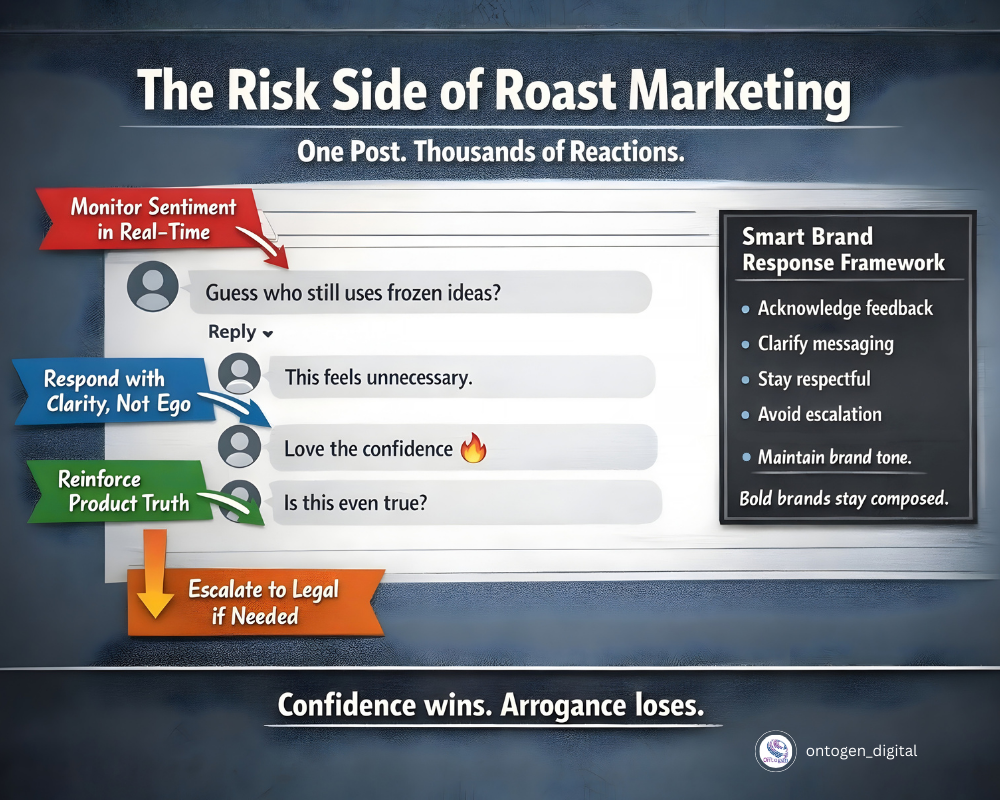
Reactive posting: Publishing a joke without a pretested response plan invites chaos when critics demand answers.
Examples of real crises (without naming brands) demonstrate that poorly judged humor tied to sensitive topics or that misreads cultural nuance can generate boycotts and long-term distrust, often costing more in reputation repair than any short-term engagement gain.
A Strategic Framework for Safe Roast Marketing (The Ontogen Digital Method)
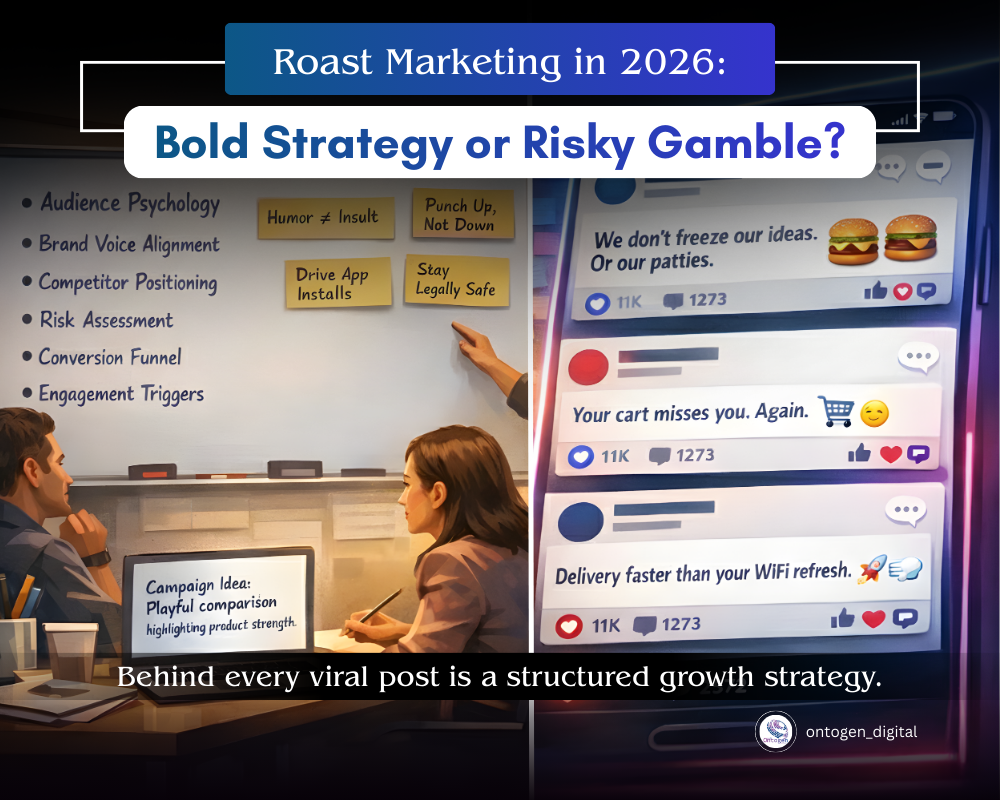
Roast marketing should be seen as a high-impact creative weapon. It can be really powerful, but it only works well when used with precision. Ontogen Digital follows a six-layer evaluation before any roast creative goes live.
Identity Check: Does the humor align with the brand’s existing voice and long-term positioning? If the brand is premium, overly colloquial roasting may erode brand equity.
Audience Mapping: Who will laugh and who will be offended? Map core and peripheral audience segments and test concepts across representative cohorts.
Advantage Anchoring: Does the humor point to a real differentiation (product strength, policy, experience)? Roasts without advantage are just noise.
Cultural Sensitivity Audit: Run the idea through a cultural lens covering language communities, religious sensitivities, and regional context, especially vital in India.
Legal Review: If the creative references competitors or claims quality/performance differences, have legal confirm non-defamatory language and verifiable claims.
Crisis Playbook: Create pre-approved responses, escalation logic, and an apology protocol. Casting content without a response plan is irresponsible.
This framework turns spontaneous wit into deliberate communication.
Execution Playbook: From Concept to Campaign (Step-by-Step)
Turning strategy into safe, measurable execution requires discipline. Below is a practical playbook you can follow:
Phase 1: Foundations
Define your comedic voice in writing: three adjectives that describe tone (e.g., “witty, humane, confident”). Map core audience segments and what they find funny. Document brand boundaries (what’s off-limits). Create a “humor bible” that compiles past successful posts, banned topics, and tone samples.
Phase 2: Idea Generation & Testing
Ideation should be collaborative across creative, legal, and brand leads. Produce 5–10 ideas per campaign, then run internal A/B tests with small audience panels. Use qualitative feedback to refine the premise.
Phase 3: Anchor to Product
For each creative, write a short “value link” statement: how does this joke link to product behavior? If you can’t write the link in one sentence, reconsider.
Phase 4: Prelaunch Safety Checks
Run the cultural and legal audits. Ensure translations into regional languages preserve intent and don’t introduce new meanings. Prepare crisis responses.
Phase 5: Launch & Monitor
Publish during windows of high relevance (events, festivals, matches). Monitor live metrics (engagement, sentiment) and social listening. Assign a human “response owner” to the thread.
Phase 6: Iterate & Measure
Measure reach, sentiment polarity, share of voice, inbound traffic, and downstream conversion. Evaluate long-term sentiment changes using brand tracking tools.
This disciplined pipeline ensures creativity and control coexist.
Measuring Value: Beyond Vanity Metrics
It’s tempting to equate viral reach with success, but in the realm of roast marketing, the true value is in sustained brand lift and conversion influence. Key measurement components include:
Engagement quality: Depth of comments, thematic consistency, and sentiment not just raw counts.
Share of voice: How much of the cultural conversation did your brand own compared to competitors?
Brand lift: Using surveys and brand tracking to measure changes in recall, favorability, and consideration over time.
Conversion influence: Short-term traffic spikes may not translate to sales; measure whether campaign audiences later convert at normal or higher rates.
Community growth: Did the campaign attract higher-quality followers who engage regularly?
Risk signals: Negative sentiment spikes, influencer pushback, or sustained critical discourse must be tracked as damage indicators.
A balanced dashboard looks at engagement and brand health together; one without the other is incomplete.
Legal & Compliance Considerations in India
Indian brands must consider evolving regulations and a complex social fabric. Practical legal guardrails include:
Fact-checking competitor references: Never make specific false assertions about a competitor’s quality that could be actionable.
Avoiding sensitive areas: Religion, caste, gender, and tragedies are off-limits unless your brand has a specialist communications strategy and an ethical reason to engage.
Defamation & advertisement laws: Ensure comparative jokes don’t misrepresent facts. If making comparisons, use generic, implied references rather than naming.
Data privacy: If humor references user behavior, never rely on user data that violates consent.
Platform policies: Each social platform has community guidelines; what passes on X may not pass on Instagram or LinkedIn.
A legal review is not a creativity checkmate but a necessary stage to ensure long-term viability. You can read about Legal & Compliance Considerations here.
Crisis Management: What to Do When a Joke Misses
Despite the best preparation, some content may provoke unexpected backlash. Having a response protocol is essential:
Pause amplification: Immediately stop boosting the post or scheduled follow-ups.
Assess severity: Is this a localized criticism, or are influencers and media joining in?
Prepare a short public response: Acknowledge concerns briefly and promise a review (if warranted). Avoid defensive language.
If necessary, apologize and explain: If the joke genuinely offended, apologize without qualifying the apology (“I’m sorry if anyone was offended” sounds weak; better: “We are sorry we got this wrong. We will remove the post and learn from it.”).
Implement remediation: Remove the content if required, adjust internal processes, and brief staff.
Rebuild: After a cooling period, rebuild trust through transparent actions, community engagement, and consistency.
Brands that act transparently recover faster; brands that hide or deflect worsen the crisis.
Practical Advice for SMEs and Regional Brands
Small and medium businesses often lack large legal teams or PR resources but can still use roast marketing effectively:
Start with self-deprecating humor or category quirks: these are low-risk and relatable.
Use local context: Hyperlocal humor (city festivals, weather, traffic) often resonates strongly without national controversy.
Avoid personal or identity-based jokes: Never target groups.
Pilot on controlled channels: Test on owned channels or close community segments before scaling.
Invest in quick response capability: Even a single well-timed reply can turn criticism into comedy if handled gracefully.
SMEs benefit most from humility; humor should humanize, not polarize.
Scaling Roast Marketing From Campaigns to Culture
If a brand decides to keep a humorous tone over time, it needs to make comedic thinking a normal part of how it works.
Hire or train tone champions; those who get the brand voice and comedic timing are just as important as the designers on your team.
Creating a humor playbook can be a useful guide for anyone looking to add some lightness to their writing or conversations. Start by gathering examples of jokes or funny stories that fit the style you want. It's important to know what topics to avoid to keep the humor respectful and inclusive. You can also write down tone descriptors to remind yourself whether the humor should be sarcastic, dry, silly, or playful. Finally, having a few response templates ready can help keep the flow going when sharing jokes or funny remarks, making sure the humor lands well with your audience. This simple framework can make crafting humor easier and more consistent over time.
Humor works best when it fits with editorial calendars and matches events and product timing.
Include brand voice performance in quarterly reviews along with campaign metrics to measure cultural capital.
When humor becomes part of the brand’s operating rhythm, it scales safely.
The Future: AI, Personalization, and Ethical Limits
Looking forward, AI will increase both the opportunities and the complexities for roast marketing. Generative tools can help create clever variations and test tonal options. However, personalization that targets individuals with humor can quickly cross ethical boundaries; humor must feel consensual, not invasive.
Regulation will tighten, and audience sophistication will rise. Low-effort, mass-produced jokes will not sustain interest. Brands that invest in human creativity and cultural insight, supported by AI for scale, will remain relevant.
Conclusion
Roast marketing can be a potent differentiator when it reflects a brand’s identity, respects cultural boundaries, and is implemented with a firm process and measurement. It is not a shortcut to awareness; it is a precision tool that requires maturity.
Short-term virality without alignment can harm more than help. Long-term, well-executed humor that consistently reinforces what the brand stands for can be a sustainable method of cultural participation and brand recall.
At Ontogen Digital we believe creativity must be connected to strategy. If you want brilliant, bold, and safe campaigns that use humor as a growth lever backed by measurement and risk controls, our team can help design the right approach for your brand.
For services that support humor-driven strategy, see our Content Marketing Services, PPC Campaigns, and Customized Marketing Strategies.
FAQs
What is roast marketing?
Roast marketing uses humor and playful teasing to create memorable brand moments, often by highlighting relatable behaviors or context.
Why do brands use roast marketing?
Because clever humor increases engagement, improves recall, and fuels organic reach on social platforms.
Is roast marketing risky for small businesses?
It can be if done carelessly. Small brands should start with low-risk, self-aware humor and test before scaling.
How do you measure success for roast marketing?
Measure both short-term engagement and long-term brand lift sentiment, recall, share of voice, and conversion influence.
When should a brand avoid roast marketing?
Avoid it if your brand requires formal credibility (e.g., healthcare, financial services) or if your core audience is conservative in tone.
What’s the first step before trying roast marketing?
Define your brand voice, set clear boundaries, and run small audience tests to validate tone and timing.